
Governance
Every answer traced. Every rule with an owner.
For the person who has to stand behind what an AI assistant tells the business: how each answer was made, who may change what guides it, and whether the answers still hold after a change.
Five questions, five answers
What a data leader asks — and where Qry answers it
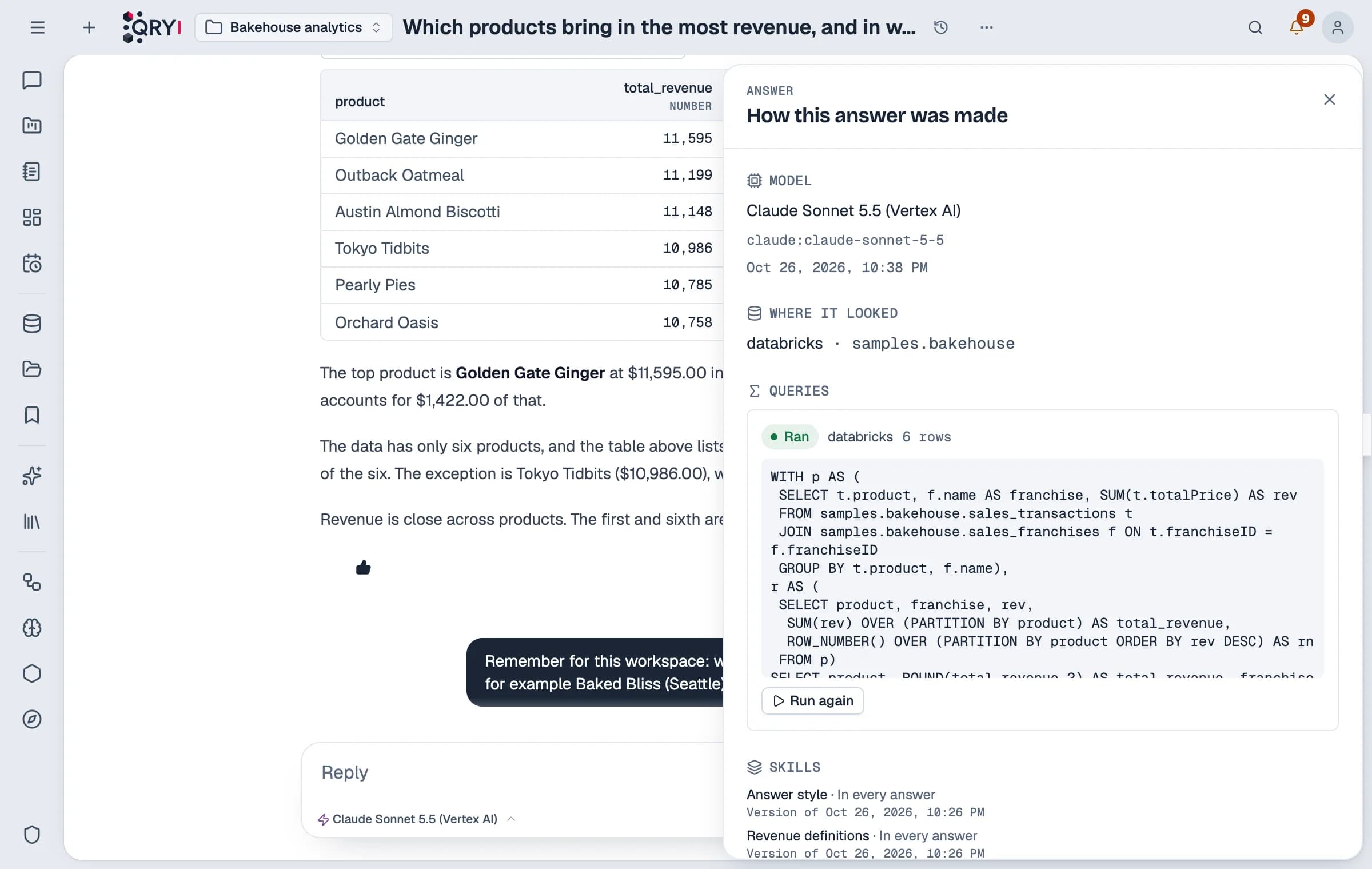
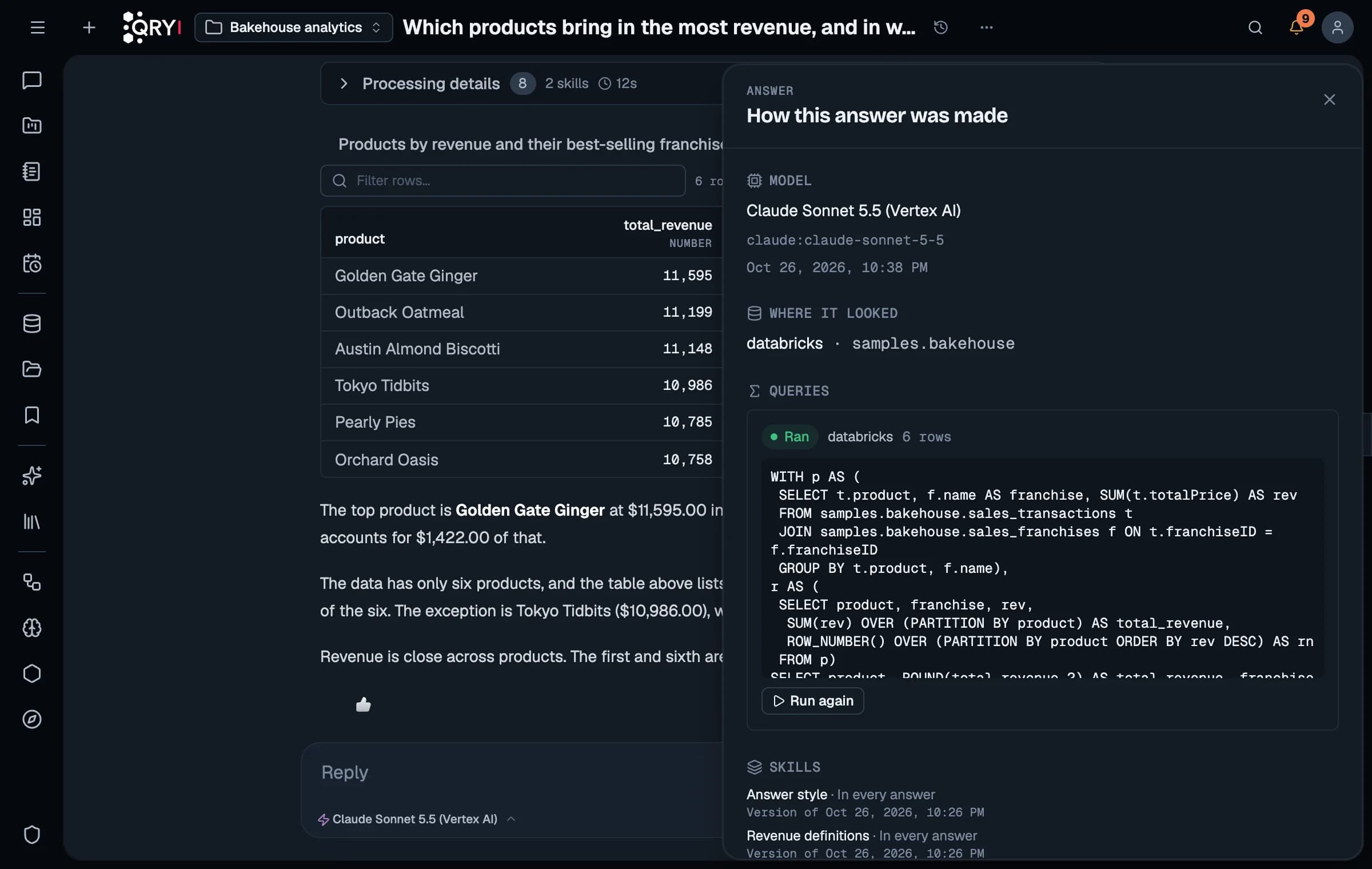
- How was this answer made?
- Under every answer: the model, the datasource, each query and its outcome, and every rule it applied — at the version in force that day.
- Does it still give the same figure?
- Run again repeats the answer's query against today's data, without the model, and says what changed.
- Who decides what guides the answers?
- Business rules and the assistant's memory can be made to change only through review: someone proposes, the owners approve.
- Who changed what, and who approved it?
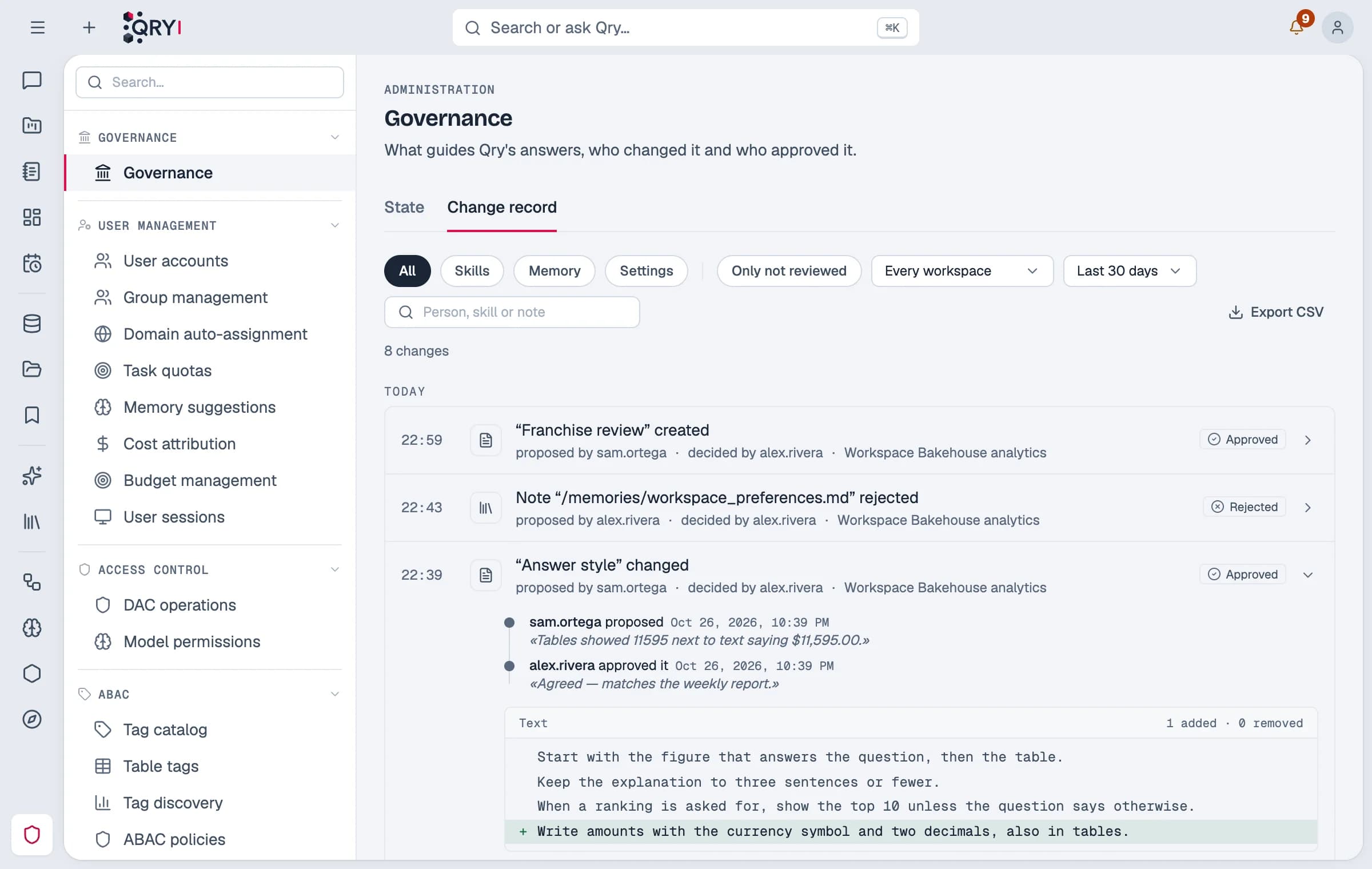
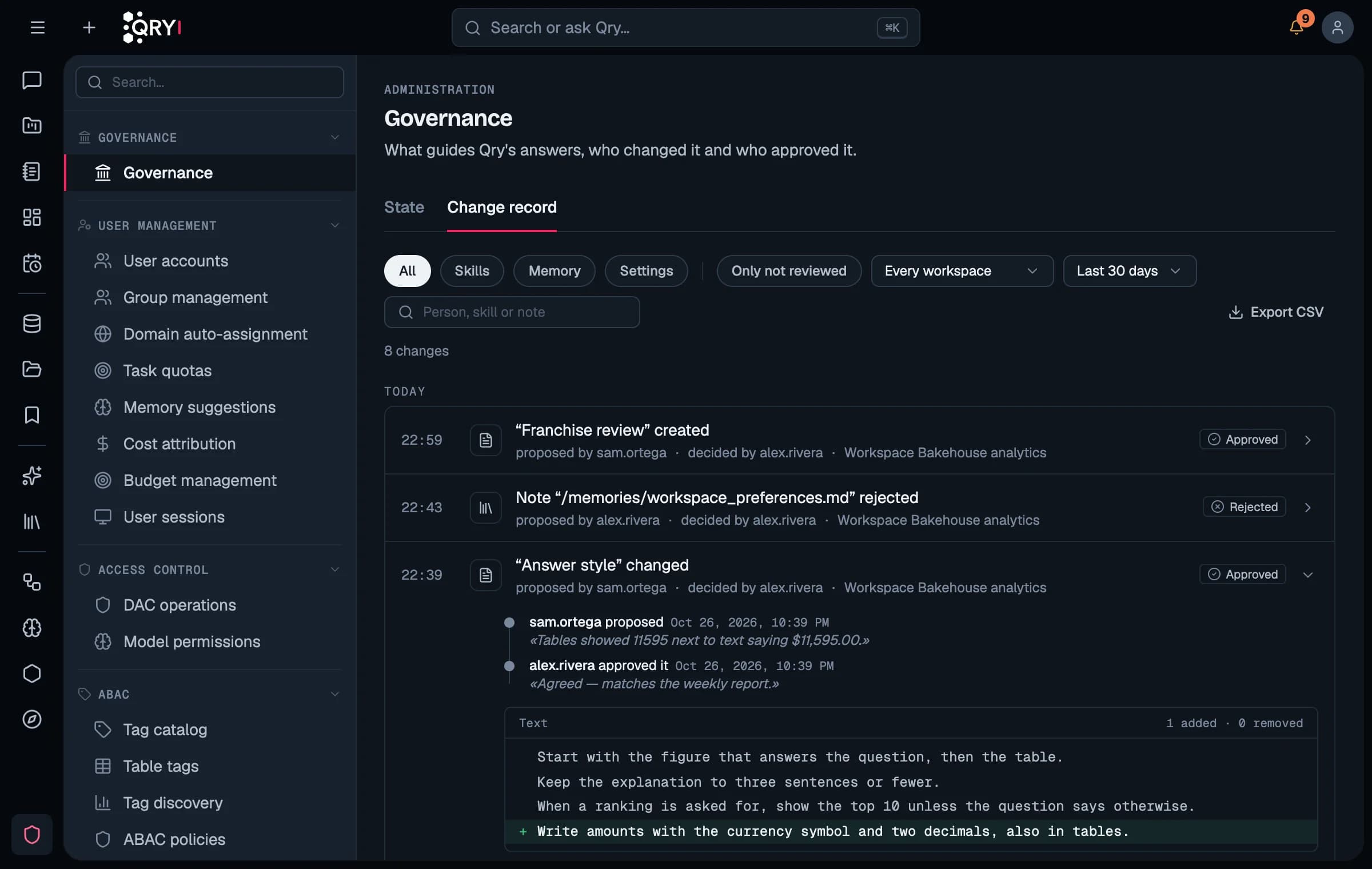
- A record of every change to rules and memory, with the text before and after.
- Are the answers still right after a change?
- The questions that matter are asked again after a new model, a rule change or an upgrade — and the run says what changed.
Who decides
You decide who may change what guides the answers
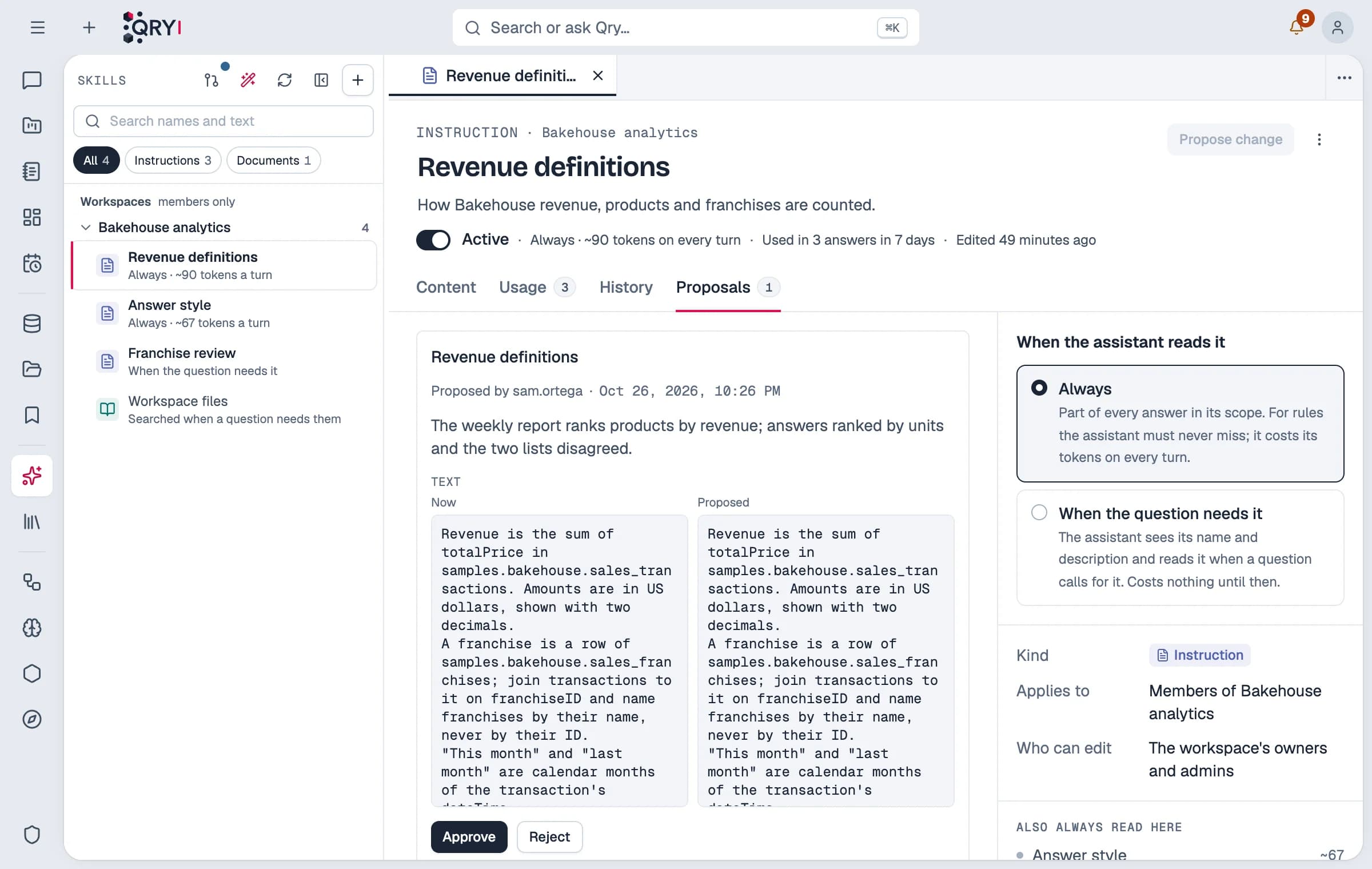
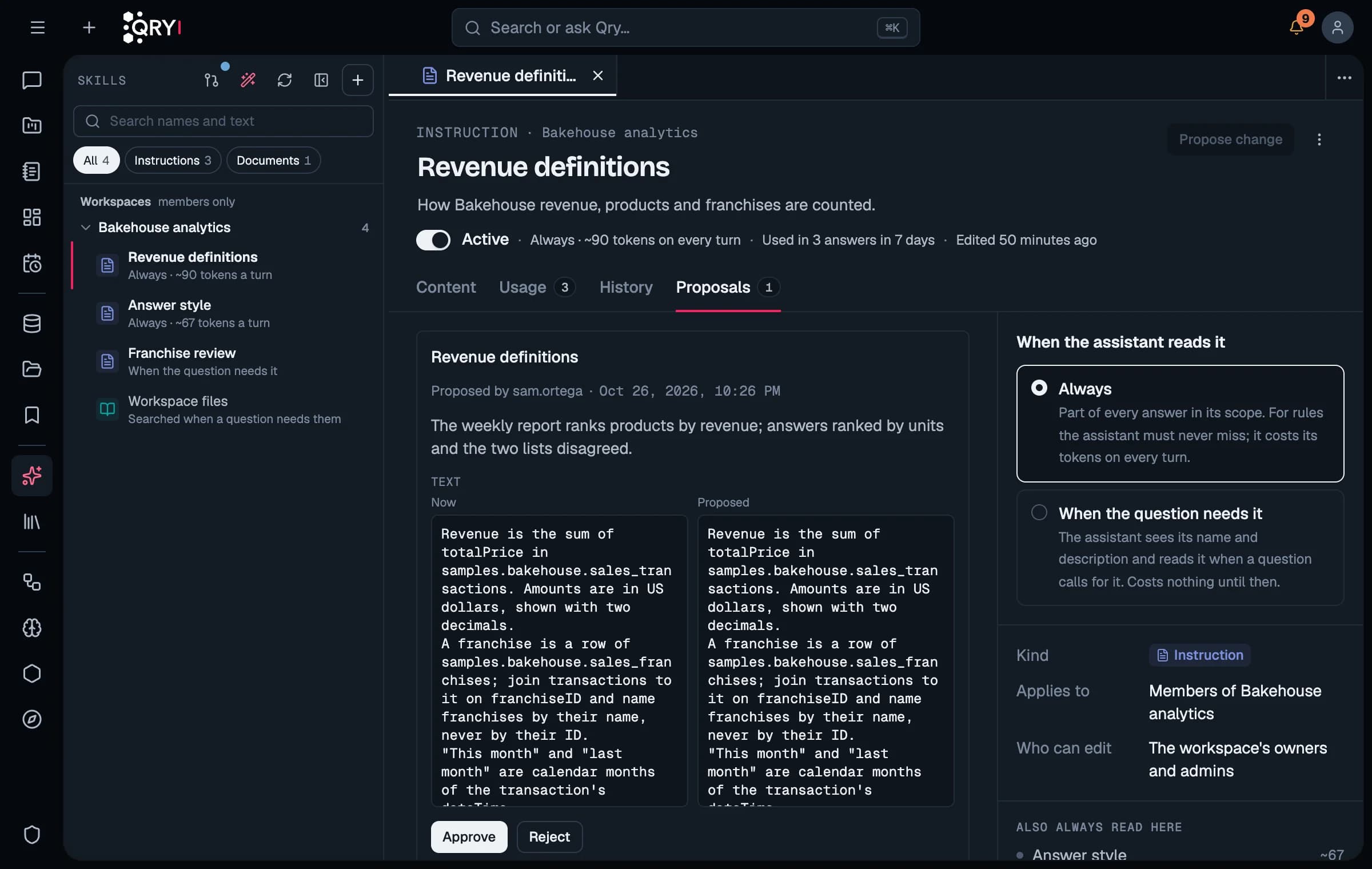
Rules are proposed and approved
A skill is a business rule written once. Anyone who reads one can propose a change; the people who own it approve it. With review on, administrators propose too — and nobody approves their own change.
The assistant's memory waits for approval
In a workspace under review, what the assistant wants to remember waits for an owner. It says so in the conversation, and later answers read only what was approved.
A good conversation becomes a rule
When someone corrects the assistant until an answer is right, the conversation can be drafted into a rule — and proposed to the owners, not applied.
Who changed it, even without review
What does not go through review is still recorded with its author. The page lists which is which, so nobody has to remember.
The record
A record that outlives what it describes
Every change to a shared rule, to a team's assistant memory and to the governance settings is recorded where it happens: who proposed it, who approved it, and the text before and after. A rule can be deleted; its history stays. When text holds personal data, an administrator can erase it — from the record and from the rule's own past versions — and the erasure is recorded too.
- Filter by team, kind and period, or show only what was not reviewed
- Export to CSV for your own audit
Answers that keep holding
A change that improves one answer can break another
- 01
People rate answers
A thumbs up or down, and — when one is wrong — why: the wrong data, a wrong figure, a misread question, something left out.
- 02
The ones that matter become checks
A rated answer becomes a check with what a right answer does, the tables it must use and, for a closed period, the figure it must give.
- 03
Checks run after every change
Through the real product, under real permissions. The judge grades the query, not a figure that moves with the data.
- 04
The run says what changed
The model, the release, the rules or the memory — so when an answer stops holding, you know what came with it.
And for who asked
Every check also verifies that the person it is for could have run its queries. A right answer they could not have got is reported as such — not as a pass.
Where the limits are
- Review is off until you turn it on: once for the installation's rules, and for each team's memory. Every change is recorded either way.
- Personal rules and personal memory reach only their owner, and are not reviewed or recorded.
- Some changes are saved directly — where a rule applies, its attached documents and scripts, deleting it — and recorded with their author, not reviewed.
- Run again repeats only queries that read, and only for the person the answer was given to.
- The record lives in your installation's database. It is complete for what it covers; it is not a tamper-proof ledger.
- Answers given before this record existed have none.
See it on your own data
We'll set up Qry against a dataset you choose and walk you through it — one hour, no slides.